


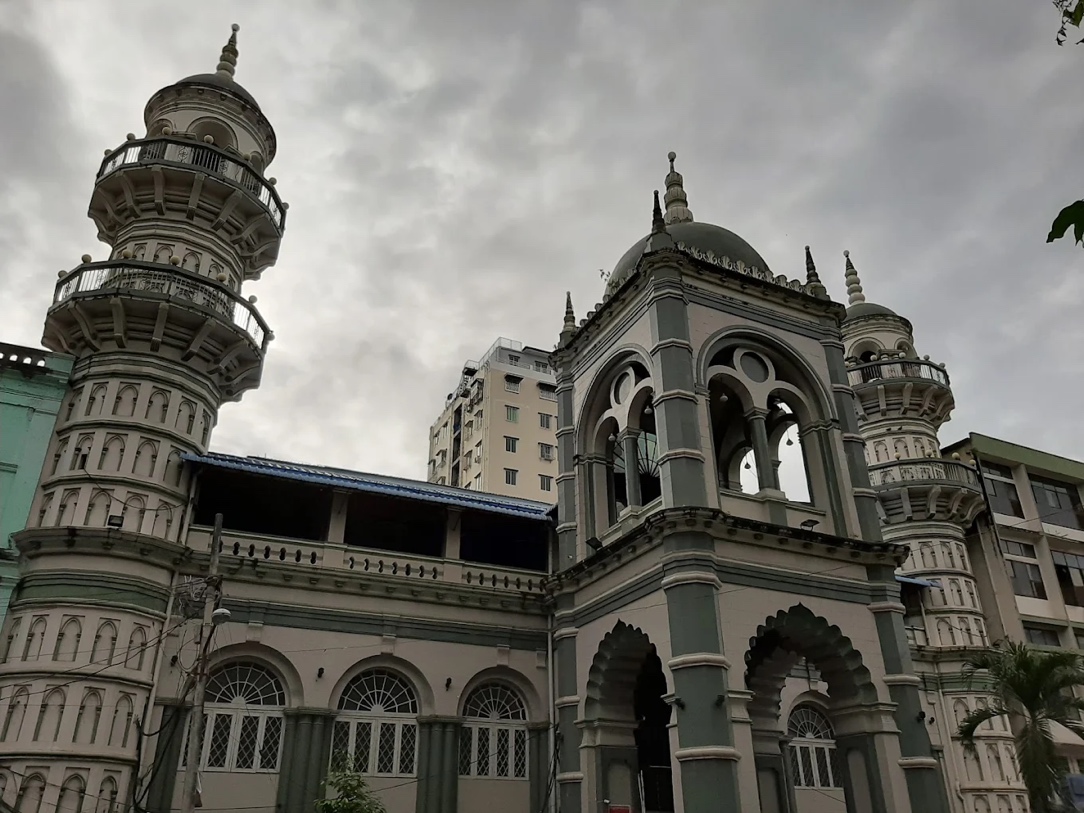
Photo Source: Internet (Alexander Soe, Local Guide)
History
Located on Shwebontha Road (formerly Mogul Street), the Surti Sunni Jamah Mosque is one of Yangon’s oldest religious landmarks, established around the 1860s. This area was the heart of the Indian community, particularly after the exile of India’s last Mughal emperor, Bahadur Shah Zafar, to Yangon in 1857. The mosque remains one of the few structures still in its original state from that era, standing as a testament to the rich historical connections between India and Myanmar during the colonial period.
Architecture & Arts
Two large minarets flank the mosque, with an imposing arched entrance tower that protrudes above the pavement, making it a prominent landmark on Shwebontha Road. While the interior retains much of its original character, the exterior is now covered in colorful tiles, blending 19th-century architecture with modern refurbishments. Its structural integrity and continuous use reflect the dedication of the congregation to preserving their spiritual heritage.
Culture & Culinary Links
The name “Surti” suggests that the mosque was built by Gujarati traders originating from Surat. This historical link persists today through shared culinary traditions; many households in Surat still feature Burmese teak, and restaurants there serve “Rangooni Parathas” and “Khow Suey” (a close cousin of Shan noodles). For those looking to taste this heritage in Yangon, authentic Indian dishes can be found nearby at long-standing establishments like Golden Chetty or New Delhi Restaurant.
Transportation & Tips
- Location: 149 Shwebontha Road, Pabedan Township, situated between Anawrahta and Maha Bandula Roads.
- Transportation: Centrally located in the heart of the business district; easily accessible by taxi or a short walk from Sule Pagoda.
- Visitor Tips: Modest attire is required when visiting the mosque grounds. Explorers may also find interest in another mosque of the same name on 35th Street, which offers a unique perspective within a narrow, historic streetscape.