

History
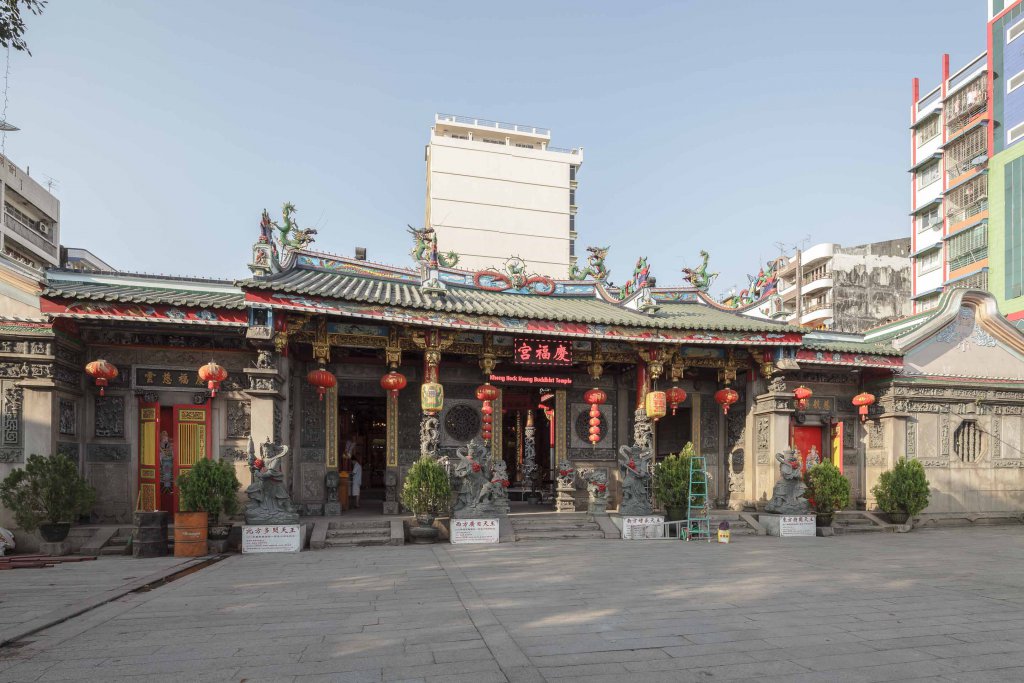
Kheng Hock Keong is Yangon’s largest Chinese (Taoist) temple, located at the southern edge of Chinatown on Strand Road. Founded in 1861 and rebuilt as a permanent structure in 1903, it is maintained by the Hokkien community, whose ancestors emigrated from China’s Fujian province. The temple’s name means “Temple Celebrating Prosperity,” reflecting the aspirations of the Hokkien merchants who settled in Rangoon during the British colonial era. For over 150 years, it has stood as a spiritual landmark for the Chinese diaspora in Myanmar.
Architecture & Deities
The temple is a masterpiece of Taoist architecture, featuring intricate filigree-like woodcarvings, sculpted pillars, and vibrant lanterns. The main shrine is dedicated to Mazu, the Goddess of the Sea, who protects seafarers and traders. She is flanked by Guan Gong, the God of Loyalty, and Bao Sheng Da Di, the God of Medicine. The temple is famous for its intricate “beams and joints,” decorated with gold and vermilion, which have captivated visitors for over a century. Legend even says the Goddess of Mercy, Guanyin, appeared during WWII to shield the temple from bombings.
Culture & Living Heritage
Kheng Hock Keong remains a vibrant center of daily life in Chinatown. Worshippers visit as early as 5:00 AM to offer incense, flowers, and “spirit money” before starting their workday. The courtyard serves as a communal gathering space where elders play chess and socialize. It also houses the offices of the local Fukienese Association. Despite historical challenges, such as the anti-Chinese riots of 1967, the temple has remained a resilient symbol of the Chinese community’s cultural identity and enduring presence in Yangon.
Transportation & Tips
- Location: 426-432 Strand Road (Corner of Latha Street), Latha Township, Yangon.
- Transportation: Easily accessible by taxi or as a key stop during a walking tour of Chinatown.
- Best Time to Visit: Early morning is ideal to witness local devotees making offerings and the tranquil community atmosphere.
- Visitor Tips: As with all sacred sites, please dress modestly. The temple celebrated its 150th anniversary in 2011 and continues to be one of the most photogenic and historically significant sites in downtown Yangon.